
Policy That Works, for Students Who Work

Founded in 2008, the University of Calgary’s School of Public Policy is one of Canada’s leading centres for applied public policy research, education, and public dialogue.
Since launching its Master of Public Policy in 2011, the School has built a reputation for rigorous, interdisciplinary, practice-oriented education, producing more than 225 graduates and contributing directly to policy conversations across government, industry, and civil society.
Canada is entering a more volatile policy era.
Economic pressure, geopolitical disruption, affordability concerns, and shifting international relationships are forcing institutions to move past politically acceptable ideas toward practical, executable solutions. For the School of Public Policy, this moment created both urgency and opportunity. The assignment went beyond marketing programs more effectively. The School needed to clarify its own role in a changing Canada.
SPP’s flagship MPP had become increasingly respected and selective, with applications rising roughly 200 per cent over time while admissions remained stable. That success exposed a constraint: the traditional, full-time, in-person model could not fully serve working professionals, career-switchers, and students unable to step away from income or family responsibilities for graduate study.

At the same time, the School was preparing to launch its Laddered Master of Public Policy and bring the Master of Sustainable Energy Development more clearly into the graduate portfolio.
Students now weigh graduate education as a financial risk.
Research showed that prospective learners evaluate programs through the lens of return, flexibility, and employability. They were looking for practical, professionally relevant education that could fit within the realities of work, family, and cost of living. Employers were looking for the same thing: applied, job-relevant learning anchored in institutional credibility.
This created a clear opportunity for SPP. While many institutions still treated flexibility as a concession, SPP could frame it as proof of relevance. The Laddered MPP demonstrated that the School understood how policy students actually live, work, and learn today.
We repositioned the School of Public Policy around a simple, defensible idea:
Policy that works.
SPP could own that claim because practicality was already embedded in its teaching, reputation, and public role. The platform gave the School a challenger position in Canada’s policy landscape and brought its brand closer to the realities of its students.
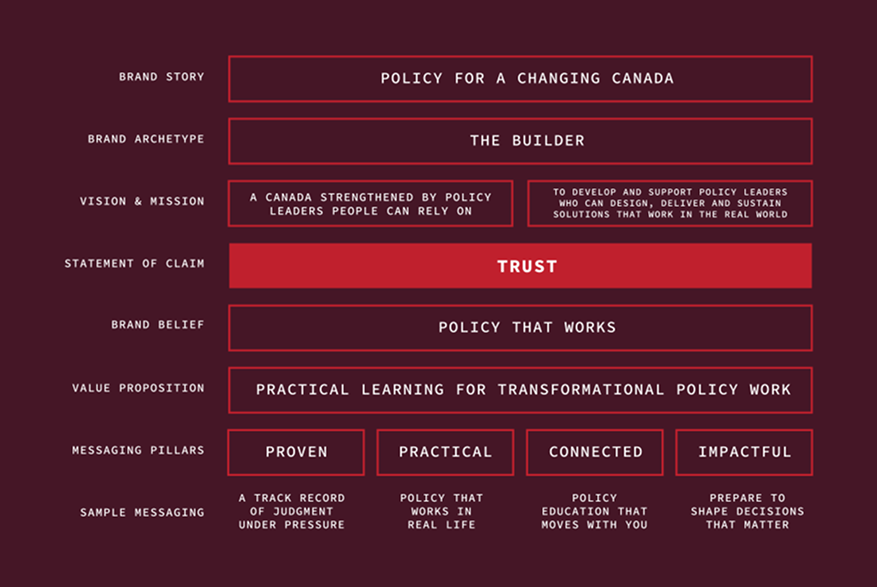
Phase 1: Brand Strategy
A unified strategy across the MPP, Laddered MPP, and Executive Certificates, clarifying the School’s narrative, positioning, audience, value proposition, and messaging architecture. The result was a coherent portfolio, connected by a shared belief that the best policy is practical and applied in the real world.
.png)
Phase 2: Creative Campaign
The creative challenge was to express academic seriousness without falling into the sameness of traditional university marketing.
The work needed to feel rigorous and credible, but also modern, direct, and distinct enough to reflect SPP’s challenger posture.
That led to a campaign system that was stripped back, language-led, and highly intentional. At the centre of the work is a wheel built around the ideas contained within more, expressing both the breadth of the degree and the multidisciplinary nature of the School. The verbal approach emphasized clarity, confidence, and practical value, while the visual world was designed to feel contemporary without becoming abstract.
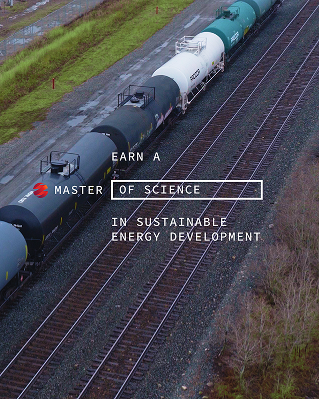
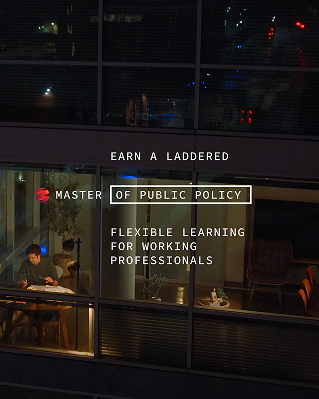
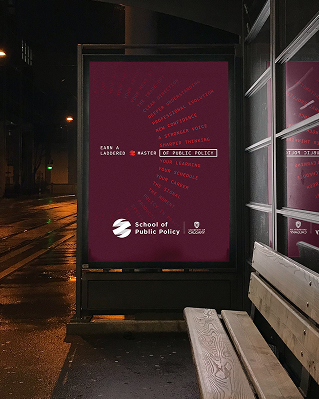

Students are looking for schools that understand the realities of their lives and build pathways that make advanced education possible.
The right message helps, but institutions also have to rethink how programs are built, delivered, and accessed. That is what made this work meaningful. By aligning its brand with student reality and using the Laddered MPP as proof of that shift, SPP showed that relevance is something a school designs for, and then earns the right to say.
.svg)
hello@brandishagency.com